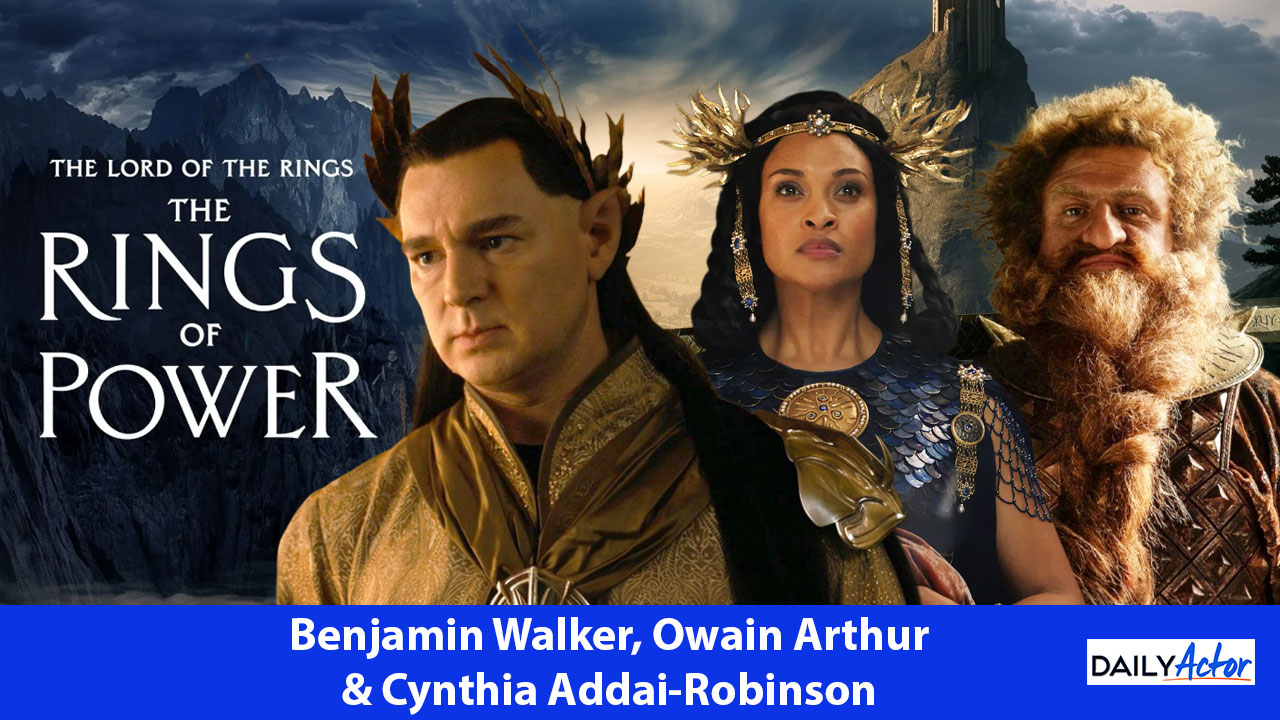
Leadership in Middle-earth rarely comes without a cost, and for Benjamin Walker, Owain Arthur and Cynthia Addai-Robinson, that means playing characters who are constantly being tested by responsibility, loss and the people who depend on them. In Prime Video’s The Lord of the Rings: The Rings of Power, Gil-galad, Durin and Míriel each carry that burden in very different ways, which gives the actors plenty to dig into as their roles continue to evolve.
At Comic-Con, Walker talked about Gil-galad as a leader who is always thinking beyond the present, preparing the people around him for a future he may not be part of. Arthur discussed how spending years with Durin has naturally deepened the character, especially as he takes on more responsibility, while Addai-Robinson explained why she has never viewed Míriel as a victim, even after everything the character has lost.
The three also touched on the hope and resilience that run through Tolkien’s work, and how those qualities shape the way their characters respond to adversity. For Addai-Robinson in particular, strength comes from refusing to let circumstance define Míriel, while Arthur teased that Durin’s family relationships will continue to be a major part of what lies ahead. This interview has been edited for length and clarity. Watch the full conversation in the video below or on our YouTube channel.
You’re each in your own ways a ruler or a protector. In the new season, how are you approaching your transformed role in keeping it together and keeping your own people moving forward as best you can?
Owain Arthur: It’s hard to play all of that, but because we’ve done two seasons now, we’ve lived with these characters since 2019. It’s been seven years we went to New Zealand for the first time, so the more seasons that go past, the more [facial] lines you get, and I think as being a King, the more lines Durin gets too. So, the more experiences that they have, hopefully the more we can kind of bring to the table. But it’s very complex.
Cynthia Addai-Robinson: I also think there’s sort of the title and then your action, more behavior. So for Míriel, she went from Queen Regent to about to be Queen, should be Queen, to now in exile and there are many, many people who for them, she is their queen.
For you, how are you going to avoid just being a victim? Because you’re a victim in a war. You’re a victim of blindness. You’re a victim of losing your kingdom. You’ve lost your father as you’re coming in.
Cynthia Addai-Robinson: I mean, it’s interesting because I guess it’s sort of a certain perspective where I’ve never felt like that for Míriel ever.
Because you’re projecting real strength.
Cynthia Addai-Robinson: Yeah, and I think sometimes you hear that phrase victim mentality, but I think for her, it’s not a situation of being anybody’s victim. It’s having a very formidable opponent who is just as strong in his conviction as she is.
Benjamin Walker: I think Cynthia’s portrayal embodies something that’s uniquely Tolkienian, which is this level of poise that is a testament to hope and faith. That that’s what Tolkien can almost be condensed to, is this cyclical nature of evil and how you muster the strength and hope to continue to try again. She’s constantly, actively fighting against it.
Cynthia Addai-Robinson: I never view any character, even in their weakest moment, as a victim of something else.
Benjamin Walker: I mean, there are some evil characters that use it as a ploy. It’s kind of like to disarm and infiltrate. But, especially in New Numenor, you’re on the back foot, but you are rallying a tribe of believers and it’s gorgeous.
Benjamin, your character carries the weight of leading an entire age. How does that responsibility shape the choices he makes in the season?
Benjamin Walker: There’s not a lot written about him, but what is written about him, it leads us to believe that he has this sense of foresight, he has this prescient nature.
I think that the introduction of the rings into Middle-earth for Gil-galad starts the process of his parenting, which is to say, I love you enough to give you the skills to survive when I’m gone. That he’s playing the long game of trying to bring out the best in those around him, even if it’s painful, in the event that I’m not there to catch you when you fall out of the tree.
I think that’s something beautiful about him as a King, and in the writing of him, that he is looking to the future in a way that is unsettling for most characters in Middle-earth, and most people on earth today. We’re struggling to get through tomorrow, much less to think about what are the people going to do that you love when you’re gone. He is a brave leader in that sense, that that is where he lives.
Owain, it’s so hard to find a functional family and marriage in Middle-earth, but now your role has changed, and we’ve heard some things about teenagers and family tensions. Will we still see that kind of familial bonding?
Owain Arthur: A hundred percent. You won’t be disappointed. In fact, it’s there and then some.
More The Lord of the Rings: The Rings of Power Interviews:
Daniel Weyman and Charlie Vickers on Finding Their Gandalf and Sauron in ‘The Rings of Power’
‘The Rings of Power’: Ismael Cruz Córdova and Jamie Campbell Bower on Arondir, Celeborn and Finding Their Characters
‘The Rings of Power’ Showrunners on Casting Celeborn, Season 3 and the Future of Middle-earth