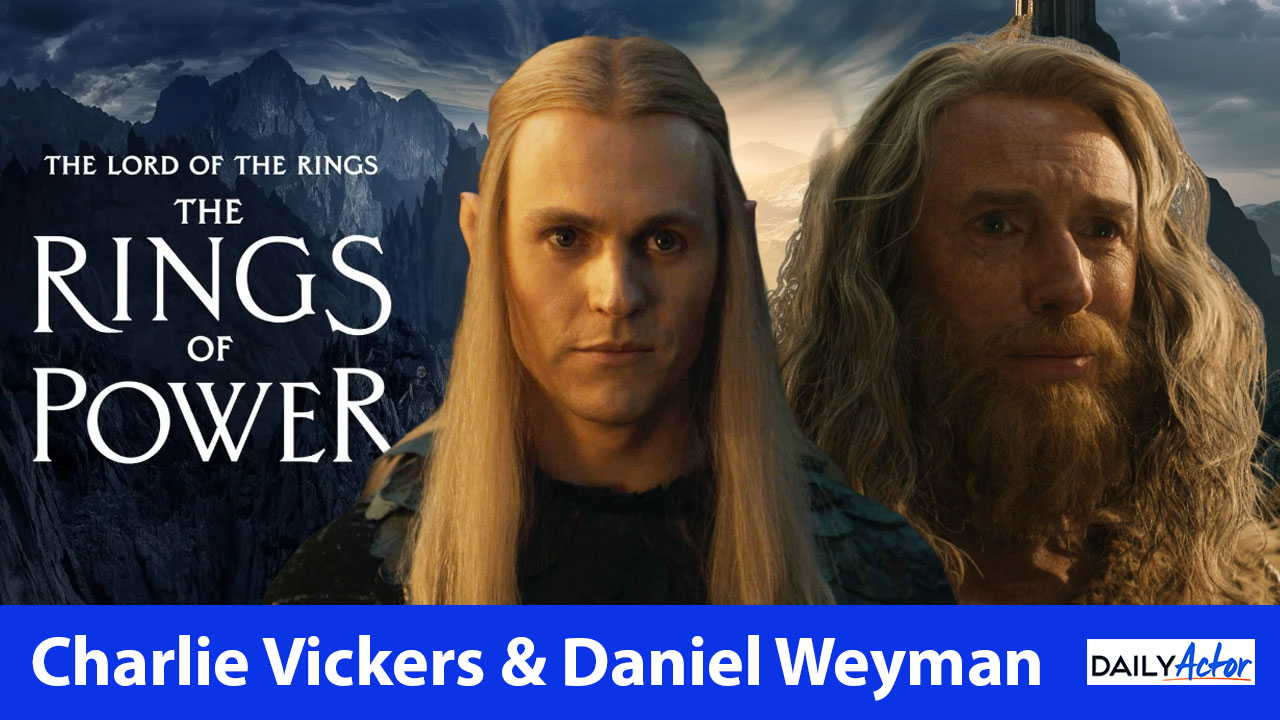
Playing Gandalf and Sauron comes with a built-in challenge: audiences already have a very strong idea of who these characters are. For Daniel Weyman and Charlie Vickers, the job isn’t about ignoring that history, but finding a way to make the roles feel personal while still staying connected to Tolkien’s world and everything that has come before.
At Comic-Con, Weyman talked about finally being able to openly embrace playing Gandalf, from putting on the robes and hat to carrying the staff on set. He also explains why he doesn’t see the character as something he owns, and how his performance is shaped by the source material, the writing from J.D. Payne and Patrick McKay and the actors around him.
Vickers takes a similarly grounded approach to Sauron, focusing less on playing a “villain” and more on what the character actually wants. He discusses Sauron’s belief that he is trying to heal and reorder Middle-earth, why having a clear objective makes the role so satisfying to play and the misconception that audiences have already seen the character at the height of his power. This interview has been edited for length and clarity. Watch the full conversation in the video below or on our YouTube channel.
Daniel, is it a relief to not carry the secret anymore?
Daniel Weyman: Yes, of course, it’s brilliant. And it’s also so exciting. Like, I do walk around and come somewhere like San Diego, and you see people dressing up and cosplaying. I get to cosplay for my job. Like, I can’t tell you, when I go into work and I get to wear those robes and the hat and have the staff, it is a dream come true.
But in a way, I don’t have ownership of Gandalf. Gandalf is everybody’s, right?
How do you keep him yours?
Daniel Weyman: Well, you know, I, as a human being, bring something, my own uniqueness to the character. And that’s sort of my own talent, right?
But a huge amount of Gandalf comes from the source material and what J.D. [Payne] and Patrick [McKay] write and how we all fit together as a jigsaw.
And I can’t just be Gandalf without a powerful Sauron upending Middle-earth somewhere and causing havoc. I can’t be Gandalf without Dark Wizards turning bad and trying to capture all his followers. So, it’s not a singular thing, it’s a joint thing, I think. That’s the way I would approach it.
Charlie, so no more deception, you’re full-on who you are, right?
Charlie Vickers: I think that’s the real joy of the season for me, is that he has a very clear purpose.
I mean, it’s really nice when you think about the theory of acting, right? He has a really clear goal, but he has a whole bunch of obstacles that he needs to negotiate.
One of the things we’ve seen with the treatment of throughout this has been a more nuanced treatment where you can see almost the heroic components. You’ve brought that to the role, at least in your own mind, I think you’re probably the hero. How will you sustain that?
Charlie Vickers: It’s interesting because I think about Sauron’s journey and one of the things that Tolkien wrote relatively specifically in contrast to everything else. And it’s very true to his text that Sauron is very much the hero of his own journey. He’s trying to heal and reorder and rehabilitate Middle-earth.
And he doesn’t see himself as a villain, right?
Charlie Vickers: No. He cannot see himself as someone that wants to destroy everything and that I’m doing the wrong thing. And I don’t think that’s very helpful for me as an actor.
And my remaining journey on this show, I’m lucky that the material is very clear that he’s doing what he thinks is best.
What’s the biggest misconception audiences still have about your version of Sauron?
Charlie Vickers: Interesting, that’s a good question. I mean, probably that Sauron is fully healed, right? And it’s kind of what we talked about.
There is actually a small misconception, I think, that the form that is released this is like peak Sauron, right? Where it’s not. It’s a stage of him on the journey. So, I would say that’s probably a misconception.
More The Lord of the Rings: The Rings of Power Interviews:
‘The Rings of Power’: Ismael Cruz Córdova and Jamie Campbell Bower on Arondir, Celeborn and Finding Their Characters
‘The Rings of Power’: Benjamin Walker, Owain Arthur and Cynthia Addai-Robinson on Their Evolving Roles
‘The Rings of Power’ Showrunners on Casting Celeborn, Season 3 and the Future of Middle-earth