One of the things about Paul Thomas Anderson films is that you never really know what you’re going to get. You might walk into one of his films thinking you understand the plot, but by the time the credits roll, he’s thrown you about ten loops you never saw coming and somehow, it all feels exactly right.
In his latest, One Battle After Another, based on Thomas Pynchon’s novel Vineland, the same holds true.
When we first meet Bob (Leonardo DiCaprio), he’s deep into the French 75, a mercenary group rebelling against a newly fascist government… gee, wonder if that rings any bells. Along with his fellow revolutionaries, including his girlfriend, Perfidia Beverly Hills (Teyana Taylor), they’re preparing to rob a bank to fund their cause.
Hot on their trail is Colonel Steven J. Lockjaw (Sean Penn), who wants nothing more than to wipe them out… and, more specifically, to get close to Perfidia. He’s got full-on creepy, unblinking googly eyes for her.
When Lockjaw finally tracks her down, the two have it out in the most biblical way possible, if you know what I mean. Nine months later, Perfidia gives birth to a baby girl and enters witness protection, leaving Bob to raise their daughter, Willa, on his own.
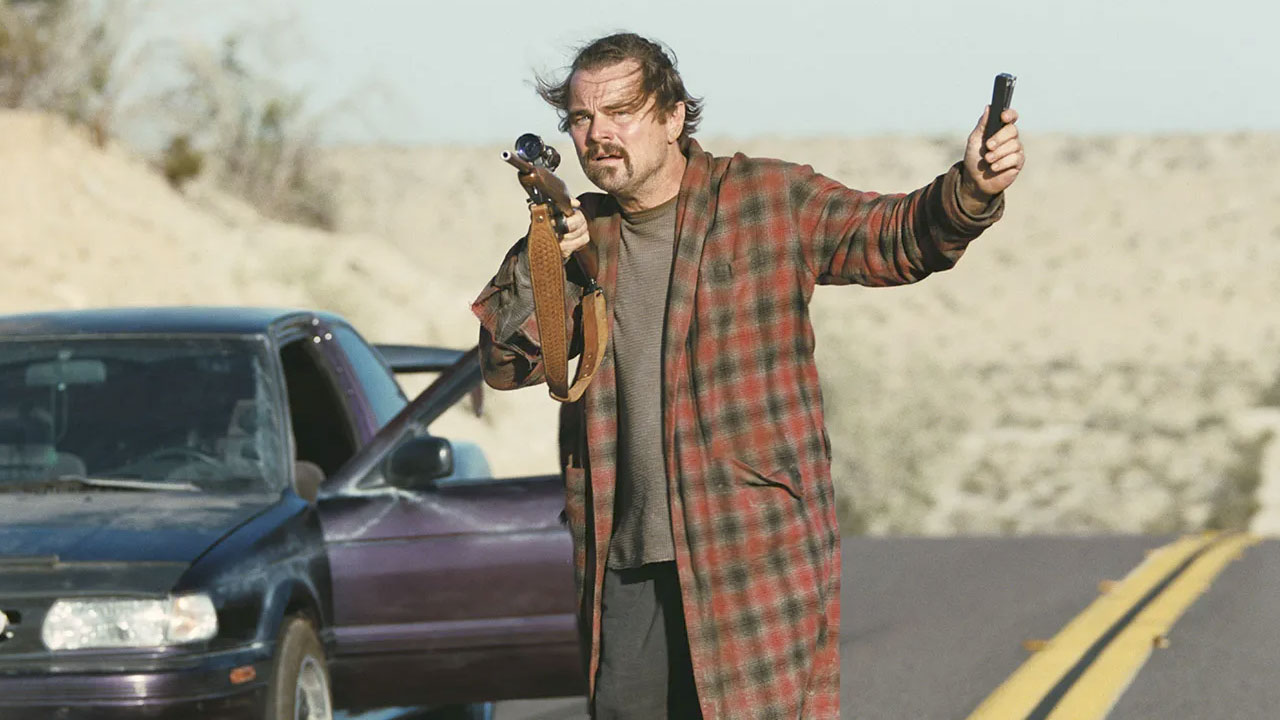
The film then jumps forward in time. Willa (Chase Infiniti) is now a teenager, and Bob is a shell of the man he once was: disheveled, paranoid, and barely holding it together. He spends his days smoking weed, watching TV, and drilling into Willa’s head that she must always watch her back.
It turns out that paranoia is justified. Lockjaw, who knows Willa is his child, is hunting her. When his goons raid a school dance, she narrowly escapes with the help of Deandra (Regina Hall), another member of the French 75.
In what may be the funniest and most unhinged stretch of the film, Bob teams up with Sergio (Benicio del Toro) to find her. Bob rants, bickers, and yells, while Sergio remains eerily calm and completely in control, a perfect balance.
As Lockjaw tightens his grip and Bob grows more desperate, the movie barrels from one absurd, nerve-racking situation to the next, truly, one battle after another.
DiCaprio cranks Bob’s paranoia and incompetence up to eleven and never repeats a beat. Watching him wrestle with his own mind, trying to claw his way back to the man he used to be, is great fun.
And Sean Penn is phenomenal. Take every tyrannical military villain you’ve ever seen and dial it up to eleven, that’s Lockjaw. Everything about him is rigid and controlled, from the way he walks like he’s got a permanent broomstick lodged up his backside to the way his face tightens and contorts as he speaks. It’s as if he’s physically holding in the man he truly is.
Willa, meanwhile, is the closest thing the film has to a “normal” character. She becomes our entry point into this insane world, and what an introduction it is.
There’s one late-film sequence that’s stuck with me ever since I saw it. It takes place on a long and empty, hilly road. As Bob chases the car carrying the kidnapped Willa, the camera stays locked on his dashboard. In the distance, her vehicle rises and vanishes over each crest, appearing and disappearing again and again. In that one part, Anderson captures the entire movie, the feeling that you’re just one hill away from disaster or redemption.