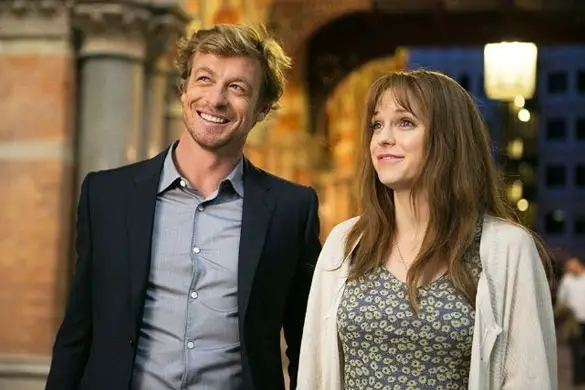
 I Give It a Year had its US premiere at SXSW and the film, starring Rafe Spall, Rose Byrne, Anna Faris and Simon Baker, got a really nice reception from the audience. I was one of the people who saw it and I quite enjoyed it. Spall is one of my favorite actors right now and I loved seeing him as a lead.
The film, written and directed by Dan Mazer, starts where most romantic comedies end and follows the first year of marriage between Spall’s character Josh and Byrne’s Nat. Things get a bit more complicated though when the two have to deal with Faris and Baker, who play two people that are possibly the ones Josh and Nat should actually be with.
The film feels more like an anti-romantic comedy, which is exactly what Mazer wanted. Mazer has worked with Sacha Baron Cohen on Bruno, Ali G and The Dictator and he brings that freshness and improv spirit to the film.
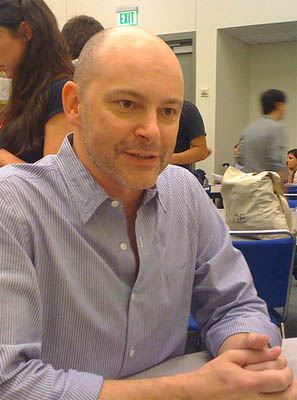
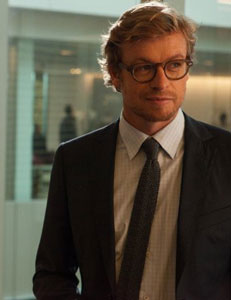
I talked to both Mazer and Simon Baker at SXSW in a roundtable interview where they were both in seemingly great moods. They were laughing the whole time and to get a true feel for the conversation you really should grab the audio version. The two talked about the improv in the movie, rehearsals and how Simon became attached.
Can you talk a little bit about improvisation in the film?
Dan Mazer: Yeah, well, I’m a great believer in things feeling natural and real and authentic and I think a lot of that often comes with a bit of improvisation. And it’s interesting because I wrote it at well as directed it, bizarrely, so you’d imagine that I’d be more precious about the words than perhaps somebody who hadn’t wrote it. But because I sort of realized the process and was sort of, “some of these jokes might be a bit shit,” I was very encouraging of the actors to sort of improvise.
And the philosophy is a relatively tried and tested one it would be well let’s have a go, let’s get the scripted words and then see what happens. And in the casting one of my sort of primary objectives was to find people who were funny and sharp and bright and witty and, you know, and I sat down with all the actors as opposed to kind of reading most of them and just kind of sat in a room and chatted with them and laughed with them and I thought, “If they do have all those attributes. If they are bright and funny and can sort of, you know, think of their feet,” which, you know, some actors can, some actors can’t, then I sort of wanted them in the movie. So, yeah, I was very encouraging of a bit of improvisation I think. Because then I essentially get the credit.
You’re OK with your actors maybe criticizing your script a little bit?
Dan Mazer: Yeah.
Like, “Hey, I think this might work better this way.”
Dan Mazer: Yeah, yeah, yeah. I mean, yeah, I hate deference in any shape or form and Simon was very good in not being deferential.
Simon Baker: You know, it’s funny because so often you get asked questions about improvisation and how it works in films and it’s such a loose term because it’s kind of… it’s always… I always think it’s like the controlled improvisation. I mean, Dan wrote it, but, you know, there’s a lot of… people get this idea that writer-directors are like, “These are my words. This is the Bible. This is the Holy Grail. Don’t mess with it.” But Dan had this sort of next step on confidence which is, “I’m cutting this thing.” You know? Which means, in essence, “I’ll take whatever is gonna come out, but before it gets passed on to anyone to watch, it’s gonna go… I’m still editing so I’m still the writer in essence.” So there was a lack of sort of any kind of fear in… I mean, I thought with Dan there was no fear.
Actually, I didn’t improvise at all. I mean, barely improvised. Depends on what I’m doing. My character didn’t really lend itself on that in this particular piece. It just, you know, obviously Rafe’s character totally was that character and Rafe and Dan had this thing where they would just go and sometimes we’d all be sort of sitting there going, “Well? Where is he going with this?” And Dan never got, like, he just let him go, which is kind of an interesting game because really when you do improv… and I improv a lot on my show. That’s sort of the role. It wasn’t suited to this. I had to sort of hit certain beats and off what other people were doing.
But it’s a very interesting game to see the trust between the director and an actor and it was interesting for me watching Rafe and Dan because Dan didn’t get panicked. This comedy stuff is, like, when it’s really, like, a full blown comedy, it’s quite serious business. “Oh, that’s funny. That’s not funny. That’s funny.” It’s like oh jeez. It’s ok if you’re doing a drama and you happen to throw a couple of gags in there because no one’s expecting it, right? But when you say, “This is a comedy.” Right? It’s like saying to a woman before you have sex, “This is gonna be some good love, mate.” You set yourself up for sort of a, you know, situation and…
Dan Mazer: I’ve never done that.
Simon Baker: Nor have I. I’m always, “This is gonna be shit, but I’ll do my best,” which is sort of what I did in your movie, right? But, yeah, so it’s interesting with that, with the rules. And also, from watching Dan, not undermining Rafe’s confidence when he is going off somewhere where it doesn’t necessarily work. He’s not going, “That didn’t really work,” because that can really crush you. Rafe had a big responsibility in this film and he was, you know, had to pull off a lot. A guy that’s sort of a twat that’s likeable and entertaining, but shouldn’t really… ok, you shouldn’t be with this girl. So it’s sort of a hard thing to do, hard ask for a character. I think he did quite well. I thought you handled that really well.
Dan Mazer: Thank you, you’re very kind to say that Simon Baker.
When you’re on the other end and you’re watching Rafe do some improv, can you feel where it’s kinda not going anywhere?
Simon Baker: Oh, no. Sometimes it was just… you know, because a lot of the time I was sort of the straight guy which just a little bit like, you know, like anything there’s the direct route and then there’s the scenic route. And sometimes it would get very scenic and we’d go, “Finally, we’re back on the main way again.”
And in my head I’m, you know, I was always often thinking, “Yeah, that one works. We’ll leave it there.” The cuts can be like a house of cards and obviously Dan knows more about this than I do in this particular film which is once you get into the edit, it can be like a house of cards where you really like this gag but in order for that gag to work, you’ve got to have this bit and this bit and this bit. Oh, shit, that bit didn’t work, so…
Dan Mazer: Yeah. And, you know, obviously I’ve spent the last 10 years with Sasha where it’s sort of, you know, a lot of improvisation and so I’ve become quite hopefully quite adept at seeing what works and what doesn’t. And, you know, often he can go off and hour and a half and you get a minute out of it and you’re constantly kind of thinking what minute is good. This by contrast was much more controlled.
Simon, what was it that drew you to the script when you first read it?
Simon Baker: You know, I’ve read a lot of romantic comedies and, you know, all of those 26 Dresses and… or, 27 Dresses.
Dan Mazer: The prequel. That was your note on the script. “I think we need another dress.”
Simon Baker: 27 is more romantic and funny. No, but, you know, I’ve read a lot of those and ever since I did that movie The Devil Wears Prada I get sent a lot of these and they always wanted me to play the guy that is an asshole, basically. I don’t know why I get that part. Anyway, they all tic these certain boxes of clichés of the genre. Right? What I liked about this movie was they actually ticked all those clichés of the genre and then flipped them all upside down. So it was like, “Ok, we’re gonna tic those boxes.” So they were all there and we’re hitting the nail on the head with all of those bits that we expect, but we’ve got a total reverse story. And I thought that was just a fresh and interesting way to go about it.
Little did I know that some people get a little bit like, “Well, what does that say about marriage? Really is this movie about marriage? Is it really kind of…” were we trying to make a piece of entertainment that takes the piss out of how far, you know, sort of how serious we are about the notion of committing to a marriage and sticking with it. I’m from a broken home. My wife is from a broken home. So many people understand divorce. You know? If they haven’t been through it they certainly know someone who has been through it. And everyone knows the dread in a relationship where you lose a friend because it’s, “Oh, no. Please. What? What does he see in her? That’s it. I can’t be friends with you anymore because I can’t stand your wife.” It’s like, “Can you come…? Please don’t bring the missus. Of course she’s invited.”
You know, the politics of that that we don’t talk about is funny and interesting and awkward and I thought that was great. Obviously if you can pull off the anniversary, the first anniversary scene, that’s the most romantic moment in the whole script, I thought, was when these two were being honest with each other and saying, “You’re not really the person that makes my heart sing.” And I thought that… I thought that was the challenge for the whole movie and I was interested in that.
Plus, you know, I hadn’t done anything like this, so it’s always a challenge. It’s always sort of interesting.
With casting, did you know Simon prior to this or how did you guys get together?
Dan Mazer: No, not at all. I mean, obviously I knew Simon’s work and loved it and thought he was brilliant and just would like to be only so lucky in order to have him. So honestly the casting process, it was like playing fantasy football for me in a weird way. I came in and go, “I love Simon in that. He’d be the perfect guy. I love Rose in Bridesmaids… very fantastic. I love, you know, I worked with Anna on The Dictator.”
So it was… it was amazing to have the opportunity to go out to these people and was incredibly thrilling when they said yes. I think universally even if you don’t like the film necessarily, or have problems with the film, universally everybody said, “My God, you’ve got an amazing cast.” Almost in a way it was kind of, “You’ve got an amazing cast. How’d you fuck that up?” But…
Simon Baker: So English of you.
Dan Mazer: So English. I got warned before hand.
Simon Baker: I’m not even English, but it’s still in there through…
Dan Mazer: Generations back. The PR people before you come to America just go, “We know you’re self deprecating. But don’t be self deprecating. Americans don’t understand it, they’ll just think that you think the film is shit.” It’s so funny. My Hugh Grant bumblings.
Simon Baker: Just don’t start the blinking.
What were the biggest challenges for both of you in flipping this genre on its head?
Simon Baker: There wasn’t really a challenge for me in that regard. It was all kinda laid out there for me. I mean, it was just the process of doing it, which always has its sort of little challenges here and there, but no real major challenges.
Like Dan is saying, the idea of what a romantic comedy is and I… it’s a term that I don’t really like because it does set you up. You look at a film like Silver Lining’s Playbook, it’s really a drama. It’s a family sort of drama that has romance in it and comedic moments. But they’re focused on it being a story about a family and a guy kind of getting back into the family. When you do a film that is a romantic comedy, it’s like, “Well, hit me. Where’s the romance? Where’s the comedy?” You know? And if you don’t have equal parts, then you’re in trouble.
But no challenge. I don’t get to do a lot of films because of the amount of work that I do on a TV show. So when I do do something, particularly if it’s in a mainstream sort of genre like we’re looking at here, I want it to be something that’s sort of fresh and interesting and I’d rather take the chance on something like I Give It a Year, take that risk, then go and do the standard tried and true, you know, obvious choices that come along. So there wasn’t really any challenges in it for me, I mean, just logistically it was walking off one set and walking onto another is the only kind of challenge.
Dan Mazer: I think for me probably it was just to actually try and make it romantic, in some sense. Because my natural instincts, if you’ve seen my previous work, I definitely go much more towards the comedy side of things. And I have quite, sort of in life, relatively cynical view of things and kind of, you know, as a reaction to those romantic comedies I was like, “I don’t want any soppiness” because you feel like it’s selling out.
So the challenge was really to make the romance feel real and authentic within a comedy framework. I was always very confident about the comedy part of it and just needed to kind of steel myself to make the romance not really feel cheesy, hopefully. That was my challenge.
You guys mentioned rehearsals. You had rehearsals before you started filming?
Dan Mazer: Yeah, we did…
Simon Baker: Generally we have them before. [laughs]
Dan Mazer: Yeah, we did a couple of weeks. I just, again, as part of the process, I just thought it would be nice to stand stuff up and see what happened and encourage improvisation in rehearsals and play around with things and just really work…
Simon Baker: It’s pretty luxurious. It doesn’t happen very often. But it’s kind of… I think it’s really… I think it’s really good. When you really look at it, it’s sort of… it is very vague, but what it does is it gets all a little bit of the, like, have a little chat, any kind of things come out, ideas get sort of popped up sometimes when you get to shooting it, all of that’s forgotten or it’s something it’s just a process to sort of work through. That was really, I thought, that was fun and luxurious.
Dan Mazer: Yeah, it was great. And it really helps on the day you turn up at your place and, like you say, some days you just throw everything out and just, “Hold on, I wasn’t expecting that to be there and this to be there.” But often it just saves you that first hour, hour and a half in the morning of your shoot where you can actually be getting stuff on camera as opposed to kind of working things out. So, no, it was great. I loved it.