 Martha Marcy May Marlene has been getting rave reviews ever since it premiered at this year’s Sundance Film Festival. The director, Sean Durkin, won for Best Director in the Dramatic Competition at the festival and after watching the film, it’s easy to see why. You’d never guess that this was the work of a first time feature director.
The film was shot with very little money but still looks gorgeous, the script (also written by Durkin) is an actor’s dream to work on and his cast is hitting on all cylinders.
But, a lot of the success of the film comes from it star, Elizabeth Olsen. The little sister of Mary-Kate and Ashley Olsen, has gotten tons of publicity for her work on the film, and all I can say is that she deserves every bit of praise. She’s perfect in the film.
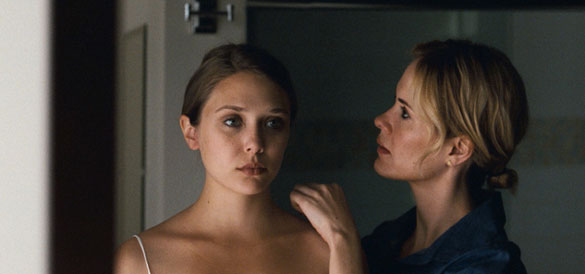
Martha is about a damaged young woman (Olsen) who escapes from a cult and its leader (the incredible John Hawkes) in upstate New York. She finds herself at her sister (Sarah Paulson) and brother-in-law’s (Hugh Dancy) house where she attempts to re-assimilate herself into the real world but the memories and paranoia are to great too wash away.
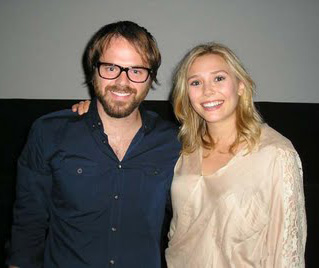
Elizabeth and Sean talked to me about how she was cast, her training, the title of the film and how she’s wanted to be an actress since she was eight.
What kind of research did you do to get into the mindset of Martha?
Elizabeth Olsen: I didn’t do any research. I got cast about 2-3 weeks before we started filming the movie. So I think like, it’s actually worked to my benefit that I didn’t. Had there been more time, I probably would have tried to find this documentary or this book, or ask Sean and I’d pick his brain about what should I do. And I wonder how that conversation would go but like, we never talked about doing research because I was never really approaching it from somebody who has been in cults. To me, it wasn’t something like that. It was just like this person needed something, wanted something, she ended up in this place. These things happened and it affected her in like A, B, and C ways.
I tried to make it as like human and specific as possible, and I figured out different ways for me to relate to her. And there were moments where I did want to know someone’s exact story, if something like this happened to someone that he spoke to throughout all of his research and so he would then share with me, like, in great detail, conversations he had with other people that inspired maybe a certain moment or something. So, there would be some research there but it was really just trying to get behind her as fully as possible.
Sean, why were you fascinated with the cult world?
Sean Durkin: It’s a hard question to answer. Initially, I guess it was really just that I was interested in… I don’t really know why. I just wanted to make a film at first about a cult and I wanted it to be modern day and local and nonreligious. And so I knew these things. And then I started to read and then I was really drawn to these women who were completely transformed by this experience and looking at what they looked like before and after, and seeing their souls sucked out of them and how it physically transformed them. It followed from there, you know.
It’s just a little like a peak of interest and then it grows, and you read more and more, and meet people and then it all grows and grows. Then you start to find the things within that subject that you get really passionate about.
I’m sure you auditioned a bunch of people for Elizabeth’s role. What was it specifically about her audition where you like, “done, that’s who I want.”
Sean Durkin: Yeah, it was that she was just different. She was different and…
In her attitude towards the part?
Sean Durkin: Everything was just like, the first read, I just remembered she had a really interesting choice and she wasn’t trying hard. She was relaxed and intense, and thoughtful and there is something about in her face, in her head, you could see something working on a much different level and that was just at the very first read and the very first audition.
Then, I had her back in and just got to talk to her a little bit more and she’s a very vibrant person. And I felt that if her personality, which is so bright, is trapped down inside of this shell that’s Martha, plus with the ease of her performance, I just thought it give it an energy and a depth.
John Hawkes and Sarah Paulson are both complete home run hitters. What was it like working with them?
Elizabeth Olsen: Well, you know, this is my second film and so I sometimes get really intimidated by the people I’m working with. Somehow, the way Sean’s attitude and the ease of the people he works with, I didn’t feel that anxiety. I was just more excited and eager to learn from them. And as actors, they are so generous. If they are not on screen, they are doing more than they ever need to do. They are just so generous and they care so much about the larger picture and they have no ego whatsoever. And so that was refreshing. Because you hear so many horror stories when you’re just starting out, you kind of get nervous and they end up just being you know, the most generous, kind, humble people you’ll ever meet. It was really, that was awesome for me.
Do you ever get intimidated?
Sean Durkin: Not intimidated, I mean, you, I don’t know.
Elizabeth Olsen: They never treated anyone as if they were above anyone.
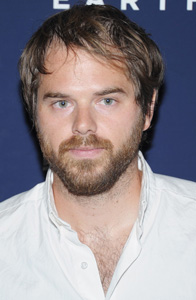 Sean Durkin: Yeah, no, definitely not. I mean, yeah, making your first film is always like a little bit of like of excitement. I mean, I’m a big fan of both of them. It just came very quickly. We just got into a rhythm and I learned a lot from them. Like Lizzie was saying about how generous they are in their performances they are giving off screen, they are just as tiring. I mean, what sticks out of my mind was when Sarah was giving, when the camera wasn’t on her, that scene on the stairs, it was like amazing performance and that’s never going to be seen on camera. It was just for the moment. Things like that I just learn so much from them.
How did you get to do your first movie?
Sean Durkin: Well, I have a production company. This was our third feature. We had a track record. We had several shorts and features at Cannes already. All different festivals, Sundance and New York. We just had a track record and a proven ability to make films for limited budgets that have high production value, great actors, and good content, and you just send the script to people and try to get them to come to work.
Elizabeth Olsen: It was a hot script on the market, I do have to say, at the agencies. It was one of those things where they were like, “This is a really cool script for our young new actor.” I only heard about that after having worked on it when I met some people at different offices in Los Angeles and I remember them telling me that. I was like, “really? I had no idea.” I was like, Martha Mary, Lois Lane?
With the name of the film, was there ever a question in your mind about marketing aspects of that?
Sean Durkin: Sure, not for me but for everyone else [laughs]. No, I just mean that in the fact that I thought of the title very early on and just felt like it was centred to the movie and to the core of her journey. And I always said, if someone can think of a better title, I’m open to it. I’m a very collaborative person and I surround myself with a lot of various talented people. And the way I work is very open, in communication and discussion and I would always say, like, “let’s think of something” and no one at any level ever came up with something. It’s a funny thing that happens is that whenever someone has hesitation, there is like a three-week period like when we’re really discussing it, where they’re like on the fence and then afterwards they’re like, “that’s the best title. We love it!”
Elizabeth, are you convinced that this is what you want to do?
Elizabeth Olsen: Yeah. I’ve been wanting to do this since I was 8. But when I was 10 years old, I asked my parents if I could start auditioning and they said, sure, and I went on to a few auditions. And my ballet teacher was telling me that I couldn’t continue ballet classes because I was missing classes because I was auditioning. I was like, “wait but I really do want to do ballet and I know I do want to be a professional dancer.”
So, there are just those things I thought about as a kid growing up. And I started doing acting conservatories when I was 16 so, I’m 22 now, so now I’ve gone to four different acting conservatories all over the world and it has been a lot of fun. Like I’m such a nerd about the actual education of acting and it’s like its history. I really just love it and I love theatre, and there is nothing else I really want to be doing. Ever. I mean I love cooking but that’s about it.
You know, as a little girl my biggest dream was to play opposite Frank Sinatra. I didn’t realize he was like an older man. So, my biggest dream was to be in one of his movies. In my mirror, I was Adelaide from Guys and Dolls all the time. So, yeah, this is what I want to be doing.
What I hope is that, you know, in making choices of what kind of films you do, I hope all of them lead to a longevity of a career because I’m not interested in like the short life of it. I’m really interested in trying to create a long career for my entire life.
 No tabloid life?
Elizabeth Olsen: Absolutely not. That sounds like hell to me, yeah.
Do you think the education, the film education that you got from school, do you think that helped you in your acting?
Elizabeth Olsen: Absolutely. I didn’t go to school for films so I actually, I’ve only taken like one film class when I was in Russia and it was really about like Russian cinematographers and editors and things like that. Who believe that, just like the satellite, they did everything before us.
But all the different acting schools I went to, even if I had a teacher that was really bad when I was like 18 at this really awful conservatory in the middle of the valley… I learned from him even though I didn’t agree with the way he taught.
And they give you so many tools, so when you’re in a situation where you are less experienced as these other actors or directors that you’re working with and you’re freaked out of your mind. At least you have some confidence that you know what you’re doing because you’ve had to do it in some other way and a lot of people learn on the job, and I think I’ve been learning a lot on the job. But its’ also helpful to know that like, I’ve created how I like to work as well and so it’s been incredibly helpful.
I’m really happy that I went to college for acting and all those things.