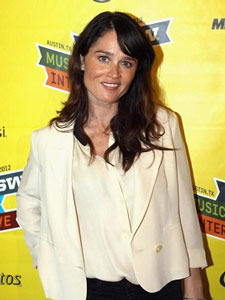
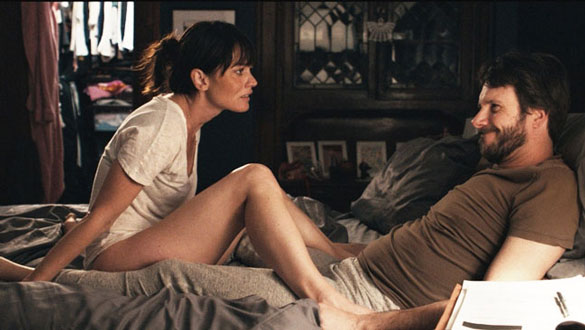
 Robin Tunney and Adam Scott star in Nate Meyer‘s great new film, See Girl Run. Tunney stars as Emmie, a restless married woman who leaves her comfortable life behind to find out what her world might have been like if she ended up with her high school sweetheart (Scott).
In 2009, Nate sent Robin the script, she loved it and agreed to do the film. But, there were two major obstacles: money and scheduling.
As you probably know, Robin has a pretty successful day job (and by successful, I mean massive hit) on CBS’ The Mentalist. The first 2 years while on her hiatus, the money wasn’t available but eventually things worked out and they finally had a shooting date. Nate told me that if Robin didn’t love the script so much, the film “couldn’t have happened otherwise.”
I got a chance to talk to both Robin and Nate at SXSW about the film, how she wanted to tackle another character and what the difference was between preparing for the film and The Mentalist.
When did you start to write the film?
Nate Meyer: I actually wrote it four years ago, and at the time had been working on another film that I had written that was in development and trying to get that going. But this one just sprang out and ultimately I put the other one aside because I really wanted to tell the story.
The first person to come on ended up being the executive producer was David Gordon Greene. Of course it’s such a strong lead female role and we were talking about various actors and he knew Robin and suggested her. Of course, I’d seen her in stuff for many years. She was the only person we talked to.
I had a long conversation with her and we realized were like minded to a large degree in the kinds of films we loved and why we do this. I sent her the script to my first film and her response to the script was all the thoughts that I had as I had been sharing it with others, with David and some other people that I had told the movie to. She just totally got it. And then we ran and that was it. Then it was just a matter of trying to get the money and make the schedule.
Robin Tunney: Trying to get the money. Everybody here has probably told you about getting the money. I work a long time during the year, and so being able to have everything sort of come together. It’s funny because movies have changed so much. It’s sad in a way, like they don’t make as many movies as they used to.
Good movies, yeah.
Robin Tunney: Bad movies too. There is less of them, so by percentage less of them are going to be good. I think that the Lex, the camera we shot the film on is going to really change movies though, because you don’t need as much money as you once needed. You know, you don’t want a film to be distractingly bad looking, it brings you out. I think there are certain movies you can tell the story on video if it’s like driven by video, like if it’s for a purpose. Do you know what I mean? Generally you don’t want that person to notice how something looks. You just want them to have feelings. This camera has sort of allowed smaller movies to look big and people don’t need the same amount of money that they once needed to sort of tell a story. I hope it will open the gates and more movies will be made that are small.
Nate Meyer: They don’t suffer from a lack of resources.
Robin Tunney: Yeah, it’s distracting. You want to be able to hear the words that the actors are saying and see the images. It’s allowed a new kind of film. There were some really good small movies last year. Martha Marcy May Marlene was so amazing. I liked Like Crazy and that was apparently made for like thirty-thousand dollars. Hopefully that will change because regular movies are just getting more and more expensive, so the stories they tell are more and more safe. Something has to be a comic book or flat out comedy, so there’s less room. Every studio is owned by a corporation and they are businessmen, and they want to know before they make a film that it’s going to be successful so there are certain ingredients that they have put in the blender that they think makes financially successful film. That’s hard.
So, from the time you were attached, how long did it take to get the money together?
Nate Meyer: Well the two things were the money, and like she said, her schedule. She works so much throughout the year. The first cycle through, we didn’t have the money and all the pieces put together when she would have been available, so then it took another year. So really, she was so committed to this for like over two years I think, maybe three.
But fortunately, I still, and I know she did, still felt the same energy from what we were trying to accomplish and what was meaningful about this story to us. And then injecting it with other actors and crew and putting it all together, the enthusiasm was still there. I feel very fortunate that she was still both available and willing after we had been through a couple of hiatuses for her and we weren’t able to make it happen. It couldn’t have happened otherwise.
With casting, describe the process of that. Did you go after certain people or did you leave it up to the was it just kind of the casting director?
Nate Meyer: It was a little bit of both. Robin actually first suggested Adam Scott. She had worked with him a couple of times. And I knew him, we all know him, I knew him from certain roles. I didn’t know that he was as nuanced and Robin assured me he was. And then I saw this movie The Vicious Kind that he had done at Sundance a couple of years earlier. Wow, totally dramatic role.
Robin Tunney: He is so amazing. Party Down is so good.
Nate Meyer: So, we didn’t have to go through the typical just generic casting channels for that because Robin had a relationship with him and David had worked with him a little bit on East Bound and Down. Then it became, “Okay, now we have two actors who are busy as hell, how are we going to get this all to line up?”
Having them involved helped us get some other talent and some of it we did with our casting director Jessica Kelly. A lot of it took place in Maine, so we found some local actors. I shot my first film in Maine so there were a couple of actors who had fairly large roles in the first film, and then they helped us out and did small roles in this movie.
Robin Tunney: And Jeremy was in a play, right?
Nate Meyer: That’s right, Jeremy Strong, who plays Brandon, her brother. Some producers had recommended him to me because it’s a tough role. I went and saw him in and Adam Rapp play off Broadway and I was just, “This is the guy.” He was great. He read the script and said, “I’m terrified of this role. I want to do it.”
Then we got to spend some time, Robin, Jeremy and I, since they’re brother and sister, we got to spend some time about a month or so prior to production just together and kind of working things out, so that once we got on set they already knew where they needed to be individually and with each other, because you know it’s independent filmmaking.
Like a rehearsal process maybe?
Nate Meyer: Yeah, it was a little bit of rehearsal and a little bit of comfort level stuff and just thinking things through.
Robin, obviously you have a day job. Is it kind of a treat to get to be able to play a different character?
Robin Tunney: It is. I mean the process changes when you’re making a television show, because it’s more about adapting. You know, all of a sudden you get a script and you’re like, “Oh, my father’s dead and I’m daytime drinking, oh my God. I didn’t know this at the beginning.” You know, that’s that process, so you sort of have to adapt. I think having something where there is a beginning, middle and an end, and being able to work from that is a real pleasure.
Also, I mean, I wanted to do something different. I would call Nate before hand and I was like, “I’m really afraid if I get tired I’m going to turn into Agent Lisbon.” I think that obviously the character you play on a TV show is not you, and that is how people see you, so the idea of doing something different is a treat.
I have a family at the show now. I know the crew very well and it’s a safe place. When somebody is working on an independent film, they are there because they want to be and they want to learn and they want to make it great. They are not there for the money because there isn’t any. Looking at the crew and the sacrifices that they made in the spirit of lets all band together and make this work, it just has a different feeling. It’s more pure. It’s not about commerce. And then again, everybody has to make a living too, so I get that.
I feel like there is a certain amount of ease with working that I didn’t have before I did the show, because I’ve been on camera for the last four years straight and made almost 100 hours of television, that you kind of don’t have the same anxiety attached to working that you used to have. You don’t notice the cameras, its become incredibly normal. So, there’s no performance anxiety. I think whenever I started something before I’d think, “My God, I shouldn’t be playing this part. I should get fired. I’m not the right person, this is really bad.” And I feel like once being in something that becomes normal and that you can let go of that, it’s great. It makes the process a lot easier. There’s fear of failing, but it’s not the fear of like the words coming out and the things that get in your way.
When you did this film, how different is your preparation as opposed to the show?
Robin Tunney: Well, like I said, you know, the show is so much about adapting and there is so much more dialogue. I knew what the script was before we started and basically knew my lines before we started.
In the show, it’s nine pages a day for 10 months out of the year, so you basically don’t have the same kind of preparation. But you’ve been playing the role so long that your memory is like a muscle, and it gets stronger for being able to absorb expository stuff. I think television moves so quickly. It is funny, because I’ll be like “Nate why are they still lighting, we need to get this done, what’s going on?” Because on TV, it is the same crew that has worked together for four years and they have two cameras and more lights and they have more money and they can move them a lot faster. And with the movie I’m like “Nate, help, we have to go.” I think Adam feels the same way, because you’re so used to like, “Okay, let’s do this.”
Nate Meyer: She was great, I mean I don’t want to speak for you. She had the script for a couple of years, for three years, and she hadn’t thought about it every day because we didn’t know when we were going to make it. But she had certainly already thought about it a lot and I think as we got closer, she really dove in more preparing for herself. I have only made, this is my second film. She had done her work and some of it was without me, which was fine. It took me a little while to get used to that, but it turned out to be the right thing, because she knew where she was and she had thought about the role plenty and the story and once we were there and I was the dealing with all that other stuff trying to make things happen, she was great because the role was already a part of her. I got over the idea that as a director, you have to get in there and do so much. When you have an actor who is experienced and talented as her, a lot of it is taken care of because she’s put in the work ahead of time, and she had. That was a real education for me.
 As a director, what are some of your frustrations with actors? Obviously, nothing with Robin.
Nate Meyer: Of course. [laughs] I don’t look at any of it as frustrations. Working with actors is the reason I do this. I went to acting school after film school. I did it specifically to learn acting. I studied with Mike Nichols and Paul Sils and some others, because I’m so interested in that part of the process and that’s what I love. This isn’t a frustration, I don’t think anything is, but one of the things that I continue to learn is that every actor is different and the processes are different. And just helping them do whatever they do best just takes a little bit of time and just have to figure it out. That’s also part of the fun, so I wouldn’t call it a frustration I would just say that it’s big part of the work, discovering for each actor what they need or what they don’t need and in some cases it’s a lot, and some cases it’s a little, and being comfortable with that.
Robin Tunney: What if he just answered, “They’ve ruined my words! The actors ruin my words.”
Nate Meyer: This sounds like a cliché, but hearing these actors say my lines that I’d written four years, at the time three years earlier, was magical. It was amazing. And to get the cast that we did and have them bring it to life, it was fantastic.
Robin, what’s your advice to actors?
Robin Tunney: I think the most important thing is that if somebody decides that if they’re going to act that they have to actually fully commit to doing it. I don’t think it’s the sort of career where you can sort of be a dilettante and dip in and dip out. You have to be willing to humiliate yourself to sort of have a career in a way. You have to really need it and really want it. Otherwise, I don’t think there’s any reason to go do it. It’s hard, long life.
It’s an interesting thing, because at times, what’s frustrating is that if anybody had any other kind of craft, like a certain amount of experience would afford you dignity and respect from other people. I don’t think that always happens with actors and I think that’s really sad. I always try to be careful when an actor who is like 70 walks onto my set at work, I don’t want them to get called in five hours early or block shoot something. I think you need to treat them with respect and dignity. But I think that people do it because they love it, because it’s a hard life for 99.9% of the people. They are there because they love it, so you have to be serious enough about it. Like, you may meet somebody and they’re like “Oh, I’m acting and traveling,” and that’s never going to work out.