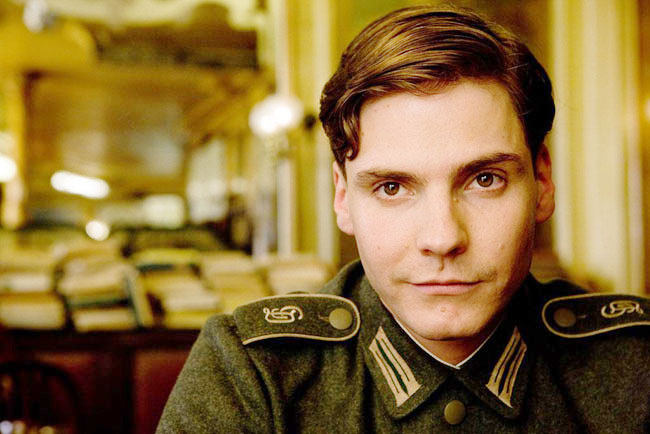
Daniel Brühl on being nervous, auditioning for Quentin Tarantino and more!
August 24, 2009 by Lance Carter
From Movieline:
It’s not going to be apparent to anyone who goes to see Inglourious Basterds, but you actually speak fluent English. Why don’t you do more American films?
Actually, it makes sense for me to stay in Europe, as I very much consider myself a European actor — also, I’m half-Spanish, and over the last few years I’ve tried to get into the Spanish cinema. So I stay here because the offers that I get for bigger parts came from Europe, not the U.S, but I’m always open to the idea. In the case of Inglourious Basterds, it just made total sense to be in it. I found it to be a very good idea of Quentin’s to choose German and French actors to play these European parts. As I said, though, I’m open to any good project, no matter where it comes from.
Was Quentin already familiar with you and your work?
Well, I was very happy to know that he enjoyed Good Bye Lenin! so much. I think it’s one of his favorite German movies of the past few years, and he said that to him, it was the kind of movie that’s started a renaissance of new German cinema. He was also in the jury at Cannes when we showed The Edukators in competition, which I think he also liked. I think he was very clear on certain parts. It had never happened to me before that I got a call on the same day as the audition of the director offering me the part, so I was very thankful that he didn’t let me wait and make me too nervous.

Were you nervous beforehand, though?
I was totally nervous! I’m always nervous doing auditions — to be honest, I hate it. [Laughs] I always envy the actors who are so cool and cold-blooded when they go in for an audition, especially if it’s for a part that you would really love to play. So of course I was nervous — plus, he was playing the scenes with me in a female voice.
He was acting out Shosanna opposite you?
Well, he was very convincing! But of course, it’s very hard to imagine falling in love with Shosanna when there’s a man sitting in front of you. So that made me quite nervous too, but I was very happy to have fooled Quentin and [producer] Lawrence Bender when they wanted me to act in French. There was no French version of the script, so I pretended that I speak perfect French and translated them right away; the words I didn’t know in French, I said in Spanish, which I speak quite fluently. They didn’t notice that and they really enjoyed the fake French, so I think that was the important moment where Quentin thought, “OK, I want to do [this role] with him.”
What’s his energy like?
What I love about him is that I can’t remember working with any other director who’s so passionate and so obsessed about what he does, and cinema in general. To him, I think cinema means everything, and it’s just very contagious for everyone around him. It’s inspiring, how he gives so much energy to everybody. What he did before we started shooting, for example, was to show movies every Thursday — he had these 35mm copies shipped from his home to Germany, and he showed these films to the whole crew to get everyone into the mood to shoot Inglourious Basterds.
Did he give you a lot of reference points for the role?
He told me that he was inspired by a real war hero named Audie Murphy, who became an actor and acted in a lot of big famous movies, like John Huston movies. He was always beside a bigger star; I remember him acting opposite Burt Lancaster, I think. He also recommended a lot of movies I had never heard of — German movies, which was quite embarrassing. [Laughs] I’ve seen a lot of German movies, but it’s impossible to compete with Quentin because I think he knows every movie that was ever shot.
You yourself were a conscientious objector who chose to do civil service instead of enlisting, and now here you are playing this war hero.
Of course, it is strange; playing a Nazi war hero makes it even harder for me. But in this fantasy of Tarantino’s, to me, that was totally OK. I didn’t have any problems with my conscience. In this movie, though, [military experience] was only important for a little bit, for shooting Nation’s Pride [the pivotal film-within-the film in Basterds]. The rest was about being flirtatious, charming, and being the nice and likable German in the movie.
Without spoiling things, there’s a pretty fantastical rewriting of German history in this movie. How do you expect Germany to take to Inglourious Basterds?
It’s such a relief, I can tell you, because we just had our premiere in Berlin. Not only was I nervous, but so was Quentin, because we didn’t know what the reaction of the German audience and journalists would be like. I had a lot of friends and family members sitting in the theater and that’s always the toughest premiere for me, at home, because you have the hardest critics. But the reaction was overwhelming — it was one of the warmest, most incredible premieres I’ve ever been to. I think there was one German journalist who wrote that this film is very important for Germany, because finally, after feeling this guilt [over the war], Germany and the Nazis get what they had deserved.


Comments
If you're not on Facebook, feel free to leave a comment here!
And if you want a pic to show with your comment, go get a gravatar!